Household electrical appliances must be resistant to ignition and to the spread of fire. The first property is tested. The second is deemed proven — as a rule, it has never been measured.
Own testing: more than one hundred material tests from over thirty appliances.
An examination within the fire-safety verification system for household electrical appliances. Presented by a publicly appointed and sworn expert for electrical and electronic installations and appliances.
This framing is taken from the introduction to the full report.
How does a small technical fault turn into a
destroyed building?
And who bears responsibility for it?
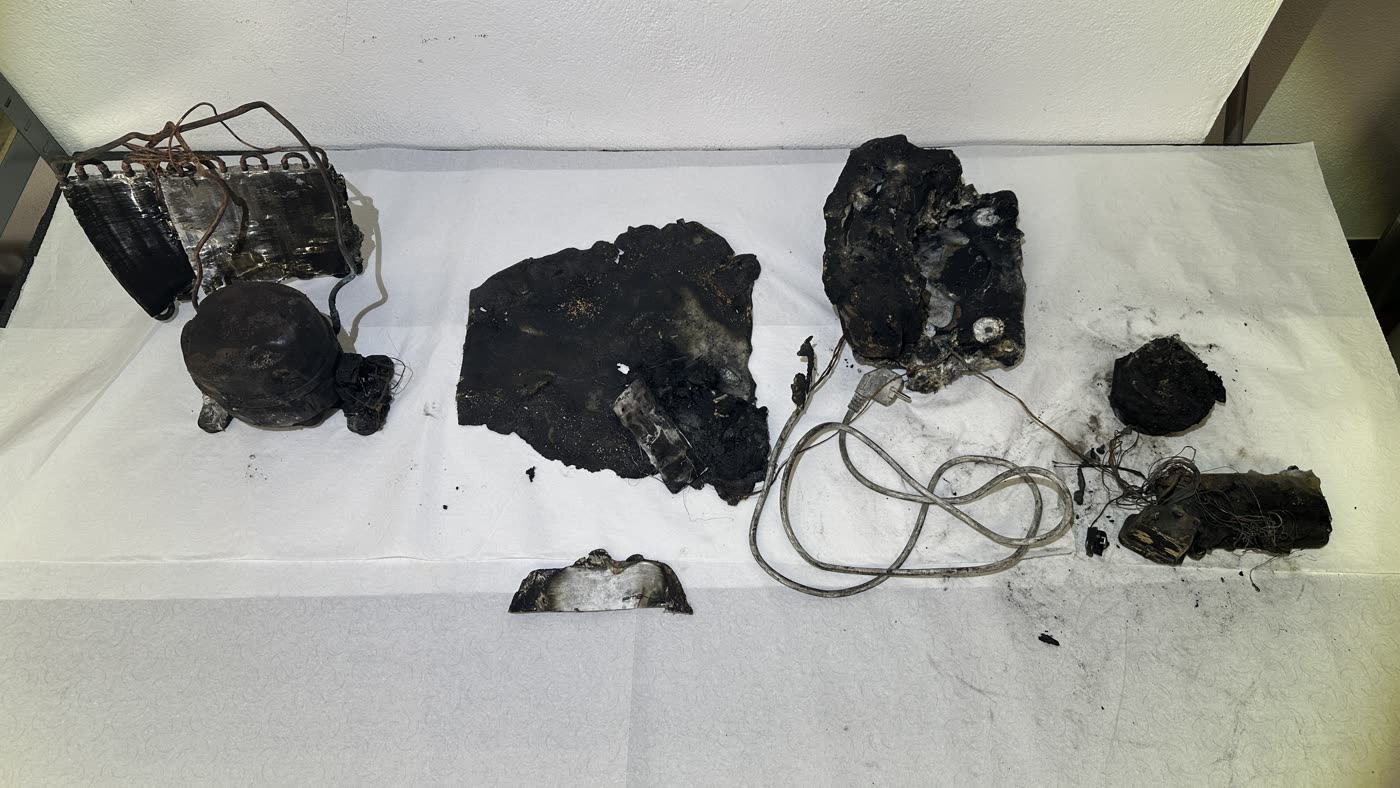
Electrical household appliances are subject to strict statutory safety requirements. They are tested, certified and placed on the market under international standards. Even so, appliance fires repeatedly do not end at the appliance itself. Flats and houses are destroyed entirely, causing high property and personal damage — in Germany and far beyond.
How can that be?
Project 550 examines the gap between the small initial technical fault and the catastrophic loss. An electrical defect explains why a fire begins. It does not yet explain why the fire leaves the appliance, spreads across combustible materials and finally engulfs a building.
The investigation follows this chain from the ignition source through the fire load into the structure of the testing and safety standards. In doing so, a possible systemic mechanism becomes visible: a test can be formally passed even though the behaviour following an actual ignition was never observed.
The scope of certification exceeds the scope of measurement.
Anyone who wants to understand how a limited technical fault can become a major fire — and how that knowledge can be used for loss analysis, evidence, liability and recourse — will find a technically and normatively verifiable approach here.
01Sources evidenced verbatim in the consolidated report.
The starting point
The sentence where everything begins.
The standard governing the glow-wire test defines its own scope. It describes a procedure for testing the ignitability of materials under a defined thermal stress.
In the same clause, the standard states what the procedure does not do. By its own wording, the assessment of fire hazard, flammability testing and the spread of fire are not covered by the procedure.
In the verification system for household electrical appliances, the same test serves as the standard route of proof for resistance to ignition and to the spread of fire. The standard is thus used for precisely what it declares itself not to cover.
The guidance document of the same series goes further. It describes self-extinguishment after a passed test as an assumption, declares the material procedures unsuitable for assessing complete appliances, and states for all glow-wire procedures that data on repeatability and reproducibility are not available.
02Clause 30.2 requires both properties cumulatively.
The mechanism
How a proof arises that is no proof.
1
The standard requires two properties.
The appliance safety standard demands both, and it demands them cumulatively. Resistance to ignition. And resistance to the spread of fire. Two properties, one protection objective.
2
One test is taken as proof of both.
The standard route of proof is the glow-wire test. A wire tip is heated to 550 °C. It is pressed against the plastic for 30 seconds. If the material does not ignite, the test is passed.
3
The second property is never measured.
The criterion for the spread of fire is tied to a condition: the specimen must ignite. At 550 °C, the plastics commonly used in appliances do not ignite. The test ends without ignition. The box is ticked all the same.
The scope of attestation exceeds the scope of measurement.
03Rendered from Planck's law, weighted by the luminous efficiency of the eye. Own calculation.
The invisible glow
See for yourself what 550 °C means.
The wire used in the standard test is heated to 550 °C. Move the slider: only well above that does it begin to glow visibly.
Relative rendering, referenced to 960 °C; not a depiction of any particular visual impression. Under normal viewing conditions, the threshold of visible self-radiation lies above the standard test temperature.
550 °C
Standard test temperature. Under normal viewing conditions, no visible glow.
The preferred values of the test temperature under the selection diagram of the test standard.
Visibly radiated power, relative to 550 °C: 1×
Own calculation from Planck's law
What is held constant is the current, not the temperature.
The procedural standard requires the heating current to be set before the test and not readjusted during it. The set temperature therefore obtains only at the moment of contact.
Over a hundred tests, no ignition.
In more than one hundred of our own tests on materials from over thirty appliances, not a single ignition occurred at 550 °C. Paper and cardboard did not ignite either (label: own testing work).
Discriminating only from 750 °C.
The test becomes discriminating at about 750 °C and reliable at 850 °C. That is roughly the range in which the wire begins to glow visibly.
Under normal viewing conditions, the mildest test level does not work with a visibly glowing wire but with a hot contact source.
04K. A. Tramm, Brandstiftungen und Brandursachen. Die Technik ihrer Ermittlung [Arson and fire causes: the technique of their investigation]. Kiel 1933, Landesbrandkasse. Quoted from the copy held in the project file.
The origin
The question is not new. It was set aside.
Fifty years before the first glow-wire standard, what is missing today was basic knowledge for every fire investigator. A 1933 handbook lists both properties side by side — and names the temperatures at which a wire begins to glow and at which a room burns.
The source
This is one of the first German textbooks on fire cause investigation, written by a court-sworn expert for fire matters with the collaboration of a regional court director and a senior official of the regional fire insurance fund. The volume was issued as training material for fire investigators.
The foreword is dated April 1933. Only the fire-technical and investigative passages are drawn upon here; the volume’s closing chapters on criminal law are left entirely aside. The book documents the state of knowledge of its field. It does not establish any present-day product requirement, and none is attributed to it here.
The glow colours
On page 22 the handbook teaches how to judge thermal radiation by the colour of the glow. These figures are practitioner’s knowledge, not a laboratory finding:
Thermal radiation can be judged, for example, by the glow colours: first red glow 525°, bright red glow 950°, yellow glow 1100° and full white glow 1500° C.
Tramm 1933, page 22 (translated)
Sixty pages later the same volume names the temperature of the event in question:
In ordinary fires, temperatures of 1000 to 1500 degrees Celsius can occur.
Tramm 1933, page 82 (translated)Glow colours and real-fire range after Tramm 1933; test severities per DIN EN IEC 60695-2-11. Own illustration.
The standard test is set 25 degrees above the threshold at which metal begins to glow visibly at all. The range in which ordinary fires take place begins above the highest test severity.
Two points, two properties
On page 10 the handbook distinguishes two thresholds. At the first, the gas ignites and goes out again as soon as the heat source is removed. At the second, the material continues to burn on its own.
At a certain point of heating, the flash point, the gas ignites; but it goes out when the ignition heat is removed. At slightly higher heating, the ignition point, flashing turns into ignition. The fuel develops gas so abundantly that the flame continues to burn by itself.
Tramm 1933, page 10 (translated)
Immediately below stands the same property as a legal term — and, in a subordinate clause, as a requirement placed on the material:
A setting on fire exists where, after the ignition process has ceased, the object continues to burn independently. In other words: the material of the object must have been heated to its ignition temperature … and must be such that it can continue to burn on its own after the ignition source has been removed.
Tramm 1933, page 10 (translated)
Igniting and continuing to burn after the ignition source is removed are treated here as two separate properties of the same material. It is the same distinction that clause 30.2 of the appliance standard requires today in a single sentence — and whose second part, as a rule, goes unmeasured. This is a parallel of terms, not a legal derivation: the criminal-law concept of arson carries no product requirement. It does show, however, that the distinction is no device of standards criticism.
Four questions, of equal rank
From the three preconditions of a fire — fuel, ignition heat, air — the same handbook derives four investigative questions that every fire cause must answer:
1Was sufficient ignition heat present?
2Was sufficient fuel present?
3Was the air supply sufficient?
4Could a setting on fire occur?
Tramm 1933, page 10 (translated)
The second question stands on equal footing with the first. Two chapters of the volume carry fire transmission in their title and treat building materials and construction specifically from that angle. Today’s narrowing to the ignition source is thus demonstrable as a narrowing: the field does not have to learn the fuel question anew. It set it aside — during the very period in which the contents of households shifted from wood, straw and natural fibres to plastics and foamed insulation.
This placement in context is an excursus. The technical investigation stands independently of it; it appears here because it shows that the dual requirement of clause 30.2 is not a new invention but part of the basic stock of the field.
05Own series of tests on components from a household appliance. Recordings without sound.
The experiments
The same components, three test temperatures.
These recordings come from our own series of tests. Each component was tested at 550, 650 and 750 °C, unchanged in every other respect.
Transparent plastic part from the appliance door.
550 °CStandard test temperature
Viewing window · 550 °C · 30 s application
650 °C
Viewing window · 650 °C · 30 s application
750 °C
Viewing window · 750 °C · 30 s application
Frame component of the loading door.
550 °CStandard test temperature
Door frame · 550 °C · 30 s application
650 °C
Door frame · 650 °C · 30 s application
750 °C
Door frame · 750 °C · 30 s application
Plastic part from the drum area.
550 °CStandard test temperature
Drum component · 550 °C · 30 s application
650 °C
Drum component · 650 °C · 30 s application
750 °C
Drum component · 750 °C · 30 s application
The recordings are uncut and unchanged in playback speed. They show the test from the wire being applied until after it is withdrawn. The sound has been removed.
Test set-up as required by the procedural standard: the heating current is set before the test and not readjusted during the application. The instrument readings are visible in the frame (label: own testing work).
What happens at the standard test temperature and what happens at greater test severity can be viewed side by side.
06Own test of 8 September 2026. Set-up and criteria as per the test standard; recordings uncut, without sound.
Putting it to the test
Ordinary toilet paper passes the test.
How demanding a test is makes for poor debate and good demonstration. So we placed in the rig the one material whose fire behaviour nobody disputes: toilet paper.
The test
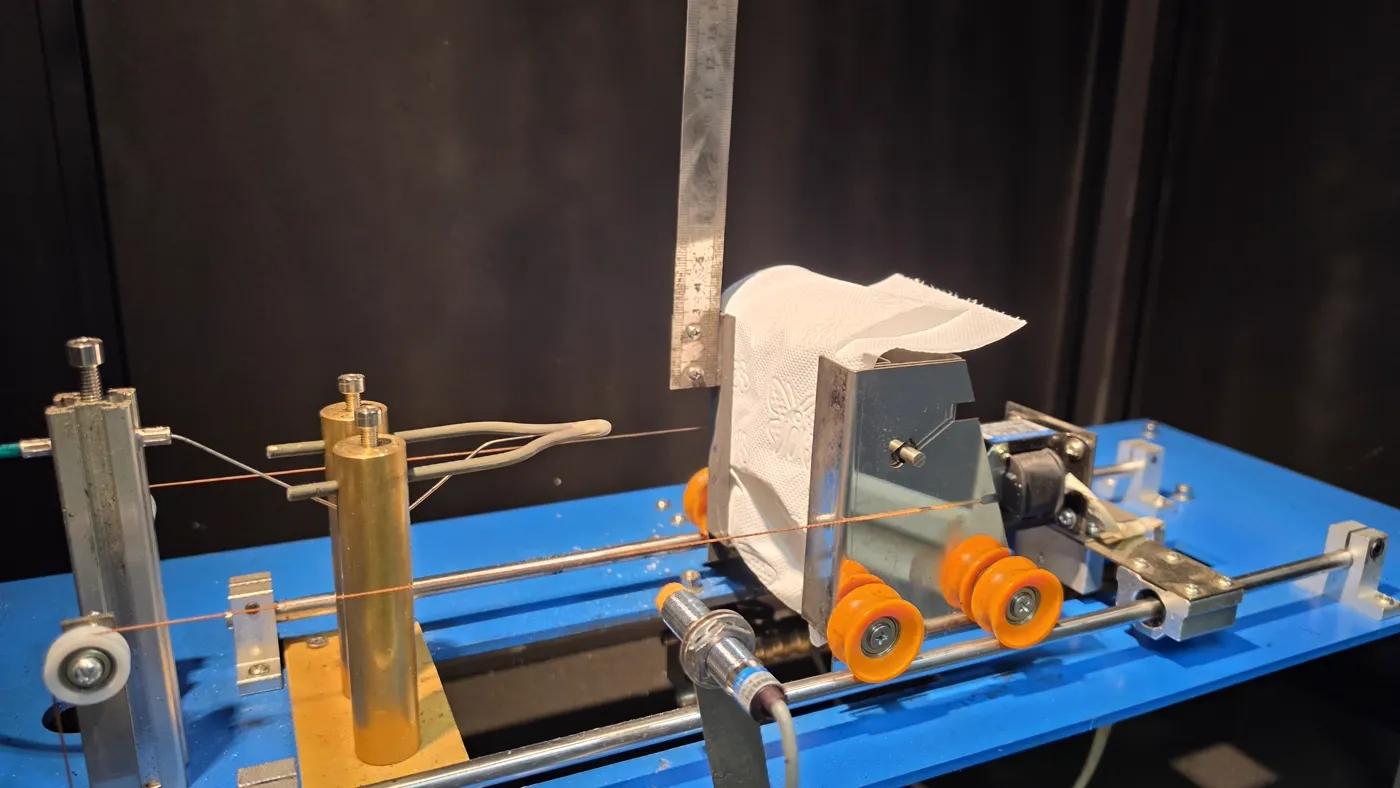
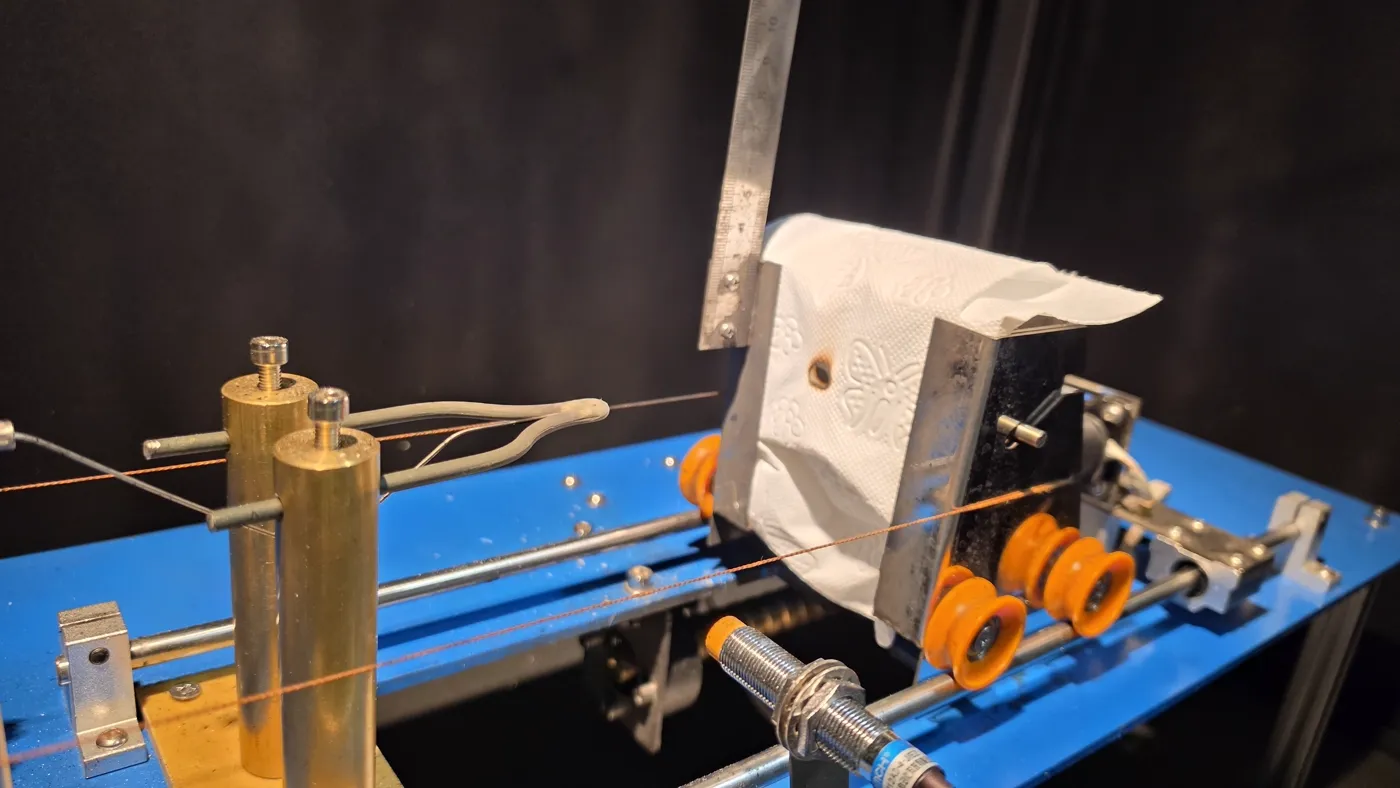
The specimen is ordinary toilet paper. The set-up follows the test standard: the glow wire is heated to the standard test temperature, applied to the specimen with a contact force of 1.0 N and held there for 30 seconds. The heating current is set before the test and not readjusted during exposure. The wire is then withdrawn and the specimen observed for continued burning.
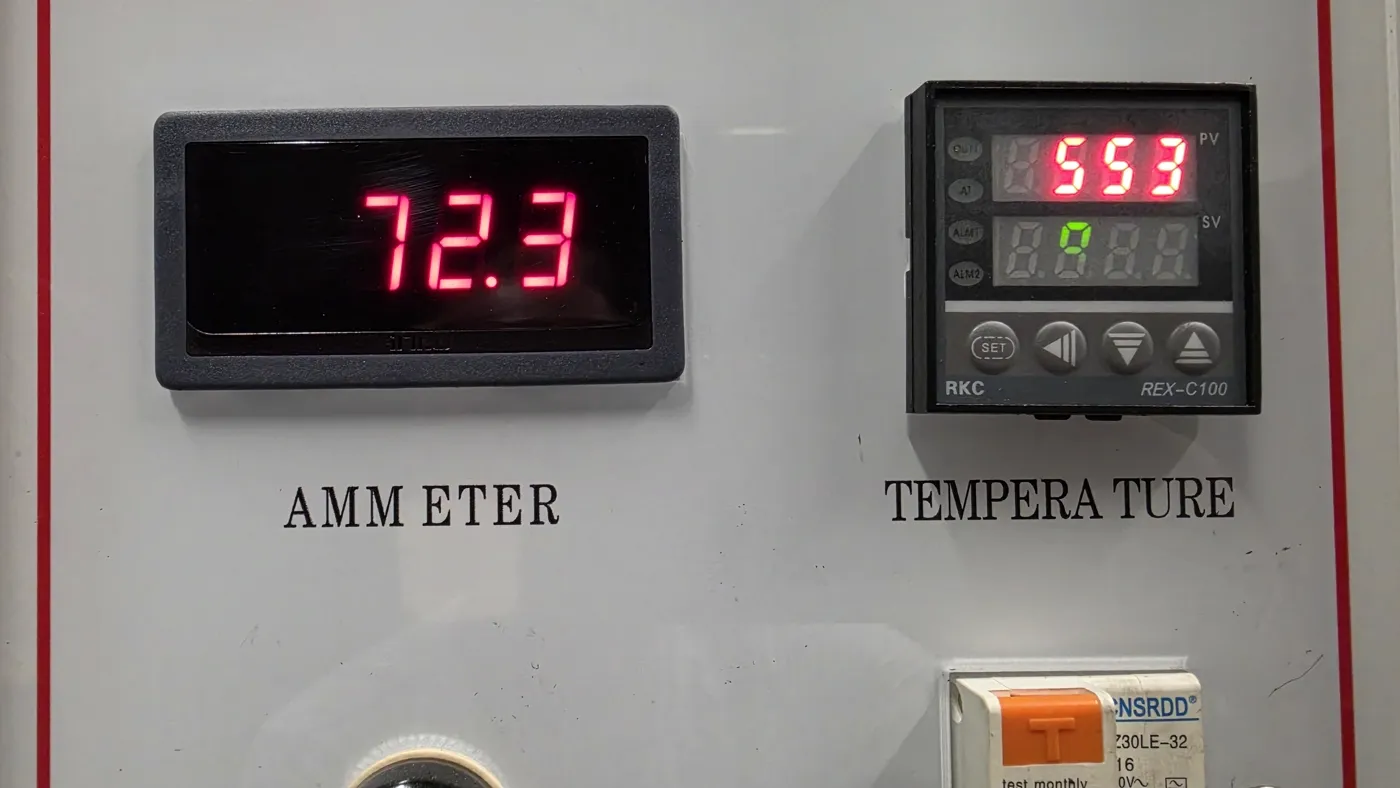
553 °C
wire temperature read at the rig; standard severity 550 °C
30 s
exposure time as per the test standard
1.0 N
contact force of the wire on the specimen
Reading at the test rig during the test: wire temperature 553 °C.
1
The glow wire being applied to the toilet paper specimen.
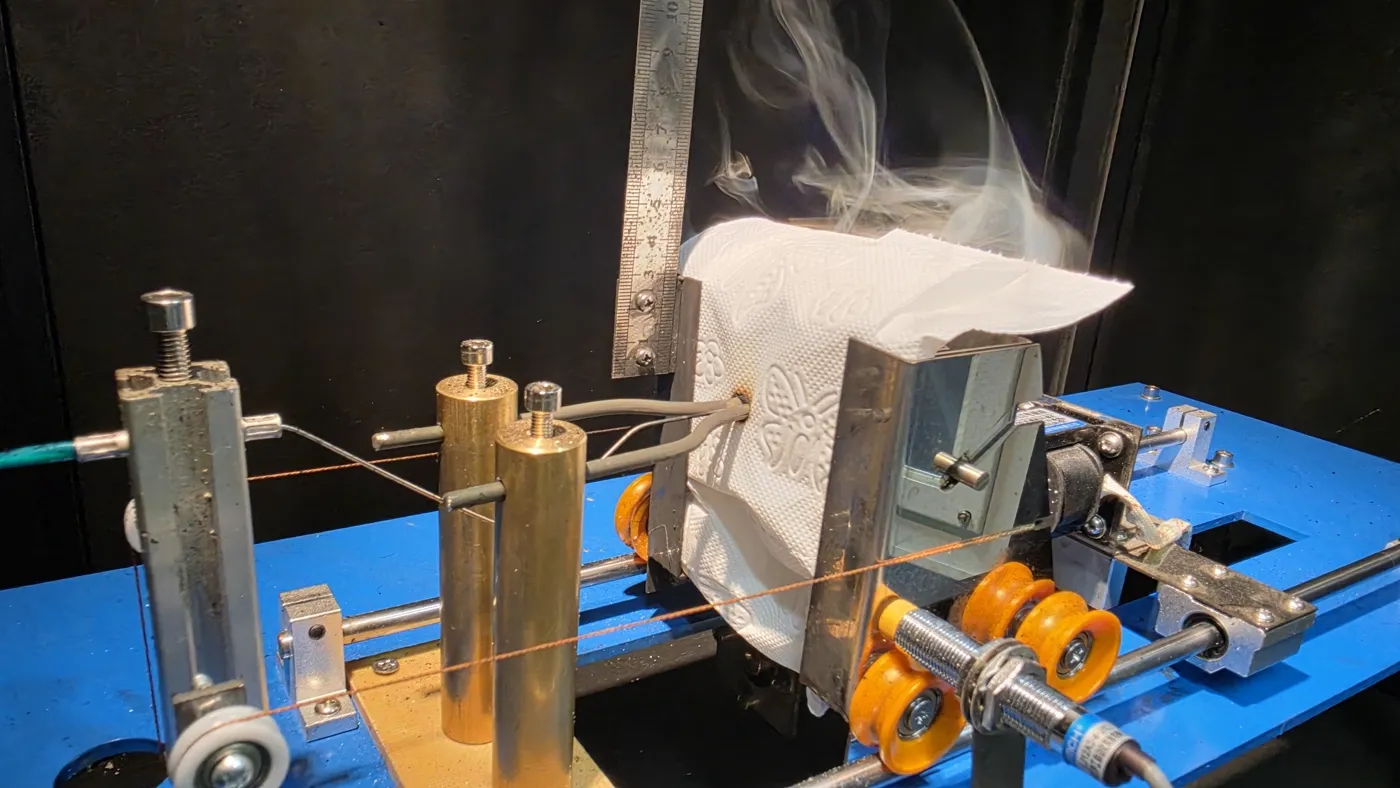
2
During exposure: smouldering and smoke at the point of contact.
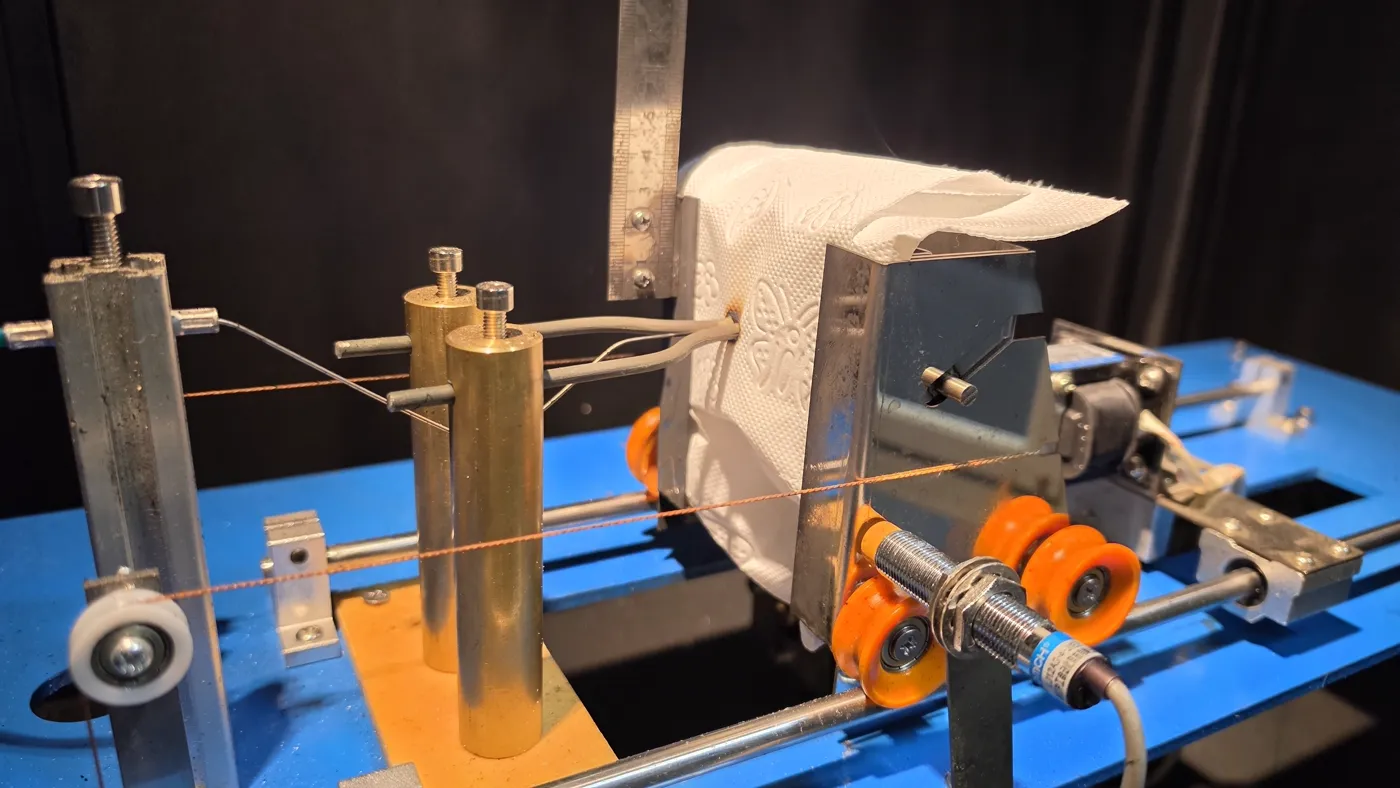
3
The process stays local; no flame develops.
4
After the wire is withdrawn, the glowing spot goes out.
Recording of the test from application of the wire to after its withdrawal. Uncut, without sound.
The result
The paper smoulders at the point of contact, discolours and smokes. No flame develops. After the wire is withdrawn the glowing spot goes out without the process spreading across the specimen. The pass criterion is met — the test is passed.
By the criteria that apply to the non-metallic materials of electrical household appliances, ordinary toilet paper is thereby resistant to ignition and resistant to the spread of fire.
A test method whose pass criterion is met by cellulose can say nothing about the fire properties of an appliance material. It does not measure the material; it documents how low the bar is set.
For comparison: the same materials at a flame
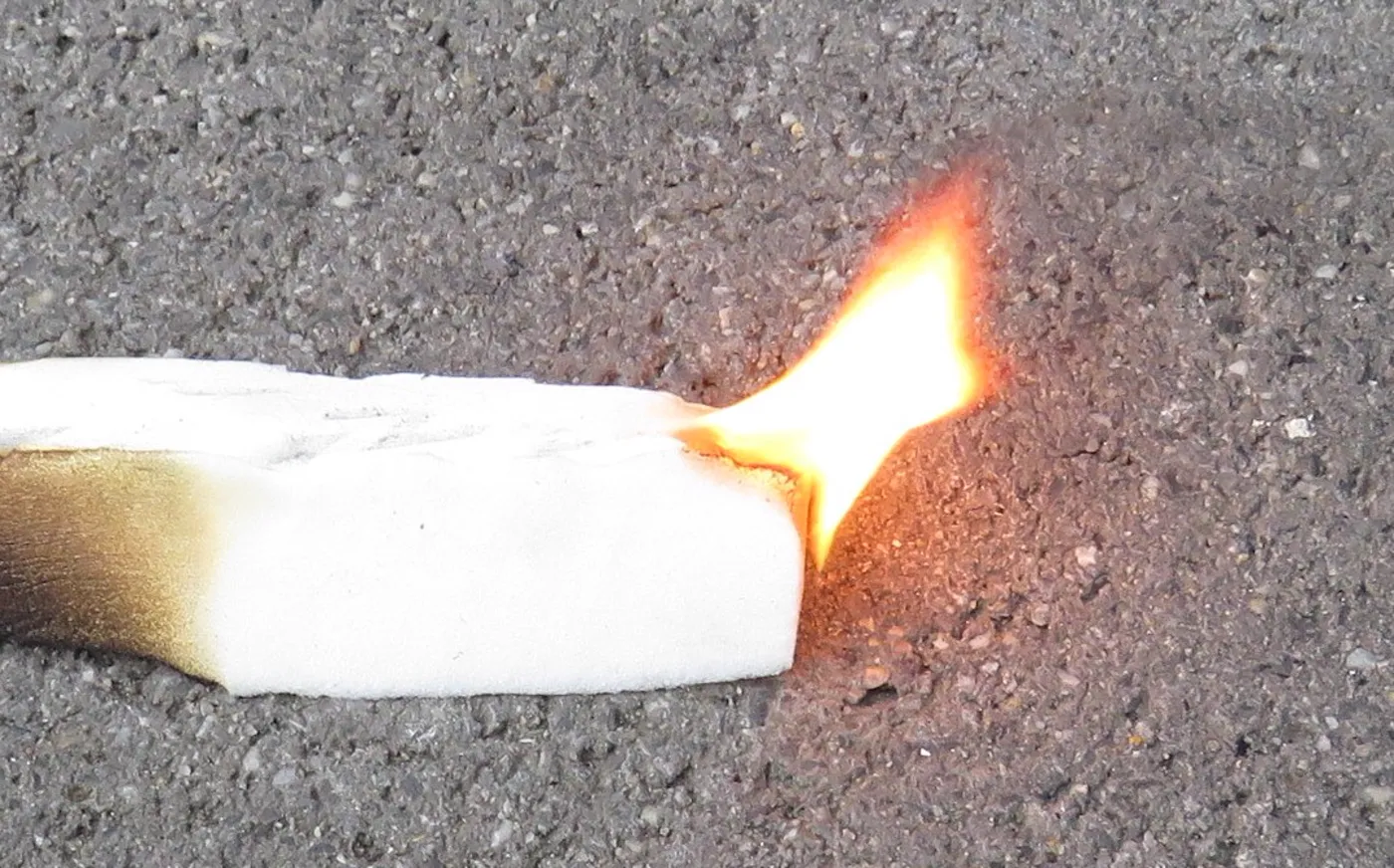
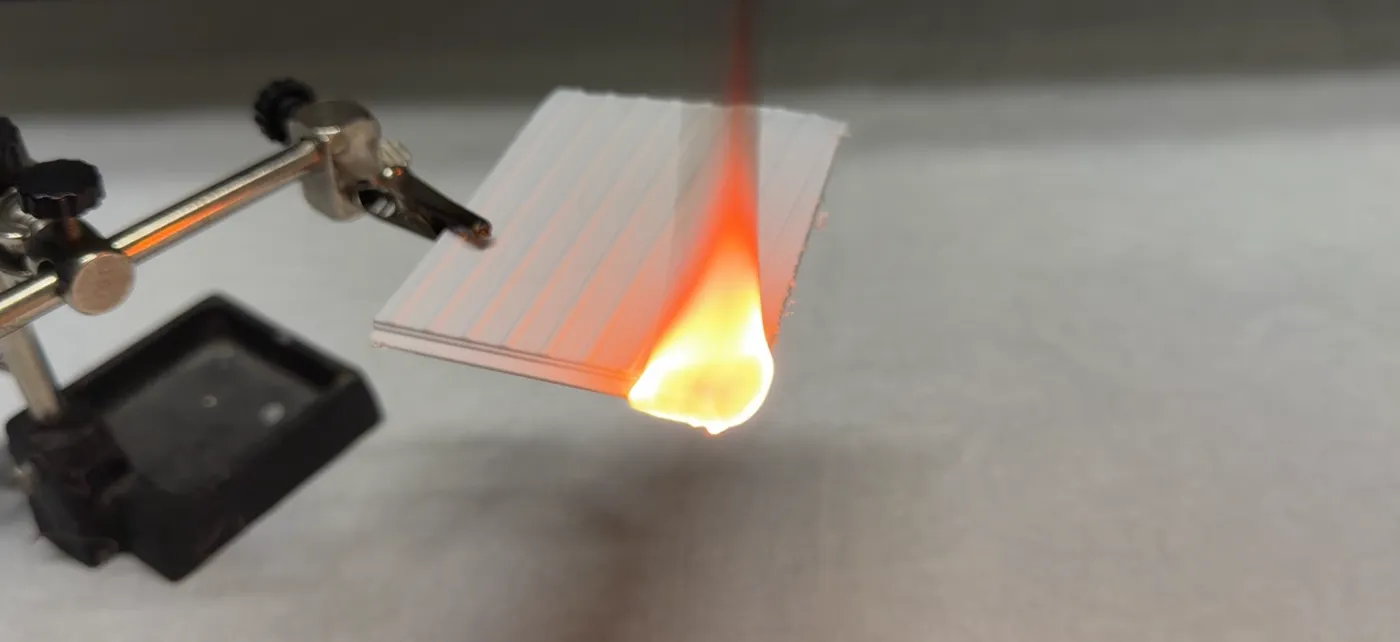
The same series covers insulation foam and appliance plastic. Under the glow wire at the standard severity they too remain unremarkable. At an open flame they behave differently — and a flame is the condition an appliance fault can reach.
Insulation foam at an open flame. The same material shows no ignition under the glow wire at the standard test temperature.Appliance plastic under the needle flame. The needle-flame test exists in the appliance standard but is not mandatory on the standard path.
What the test shows and what it does not
The test is not a conformity assessment, and nobody builds appliances out of paper. Nor does it examine the paper — it examines the yardstick. Where the requirement sits low enough for cellulose to meet it, a passed test report does not support the statement for which it is submitted.
What is assessed is the severity of the standard test level. Nothing is said about any particular appliance, any particular company, or the diligence of those who test to that level: whoever tests by the rule tests correctly. The rule is the subject.
A method that certifies toilet paper as resistant to ignition and to fire propagation is not suitable for distinguishing combustible from self-extinguishing materials.
The test was carried out on 8 September 2026 in our own test rig and documented photographically and on video. Raw recordings and the test record are supplied to professional bodies on request.
08Each finding is separately evidenced in the consolidated report and tested against the strongest objections.
The findings
The core finding is a twofold thesis.
Two strands, of equal rank. The first concerns the design of the standard, the second its foreseeable application. The findings that follow support both.
01Twofold thesis, first strandThe design of the standard
The standard secures the most risk-critical decision in the entire verification system by a note alone: the choice of test severity. There are no quantitative criteria, no safe default and no duty to document. The decisive branches are anchored in the most favourable assumptions: in the current of undisturbed operation rather than the fault current, in the clearance when new rather than the thermal zone of action, in an assumed supervision rather than the real pattern of use, and in a contact source rather than a flame. This falls short of the standards that the same body of rules sets for safety-oriented design.
02Twofold thesis, second strandThe foreseeable application
This design opens up a minimal application that was foreseeable. Large-volume fire loads, which produce the greatest hazard in an internal appliance fire, regularly enter the mildest test path by way of undefined terms such as immediate vicinity, insignificant mass and insignificant energy. These terms have been assigned to the product committees for definition since 2014 and are defined nowhere in the body of standards in force. Feed the same selection diagram with the assumptions of a proper risk analysis, and for mains-operated appliances it regularly leads to 750 °C or 850 °C.
03Supporting findingThe three branches
Where a conformity file records a test at 550 °C for a component that determines the fire load, that result presupposes three branch decisions: insignificant energy to cause ignition, absence of vicinity to live parts and, under the applicable edition, supervised operation. Each of these assumptions takes the most favourable case. The standard requires no justification for any of them and no documentation for any of them. The finding is therefore rebuttable, and therein lies its strength: it falls away as soon as the derivation is produced.
For the branch of immediate vicinity the standard gives no figure. In practice, a clearance of three millimetres taken from another clause of the appliance standard is applied by inverse reasoning: more clearance, therefore no vicinity. Yet the same figure appears in the de-minimis clause as the distance across which an ignition jumps. One value cannot mark both the reach of ignition and the boundary of safety. Other clauses of the same body of rules model the zone of action of a flame as twenty millimetres in diameter and fifty millimetres in height.
05Supporting findingThe pass logic
The assessment criterion for the spread of fire is tied to a condition. It takes effect only if the specimen ignites during the test. At the standard test temperature of 550 °C, the plastics commonly used in appliances do not ignite. The test ends before the second property ever comes up for measurement. The continued-burning and extinguishing behaviour of a material cannot be determined at all without ignition. The result nonetheless records both properties as proven.
06Supporting findingThe absent validation
The guidance document of the series states for all glow-wire procedures that data on repeatability and reproducibility are not available. According to the standards themselves, the values of the test temperatures were never validated. Another procedure in the same family was withdrawn in 2007 for insufficient repeatability and reproducibility. In our own testing, every material examined passed at 550 °C (label: own testing work, over one hundred tests from more than thirty appliances). A procedure that returns the same result across the entire range of materials tested reproduces perfectly and distinguishes nothing. The value is in the standard. The question it is meant to answer is not.
07Supporting findingThe adoption rules
The glow-wire series of standards itself governs how its procedures may be adopted into product standards. It requires relevance to the fire scenario, an examination of applicability and limitations, and four admissibility conditions for pass-fail tests. The basic guidance document expressly requires the product committees to examine sensitivity, repeatability and comparability. No documentation that these conditions were examined at adoption can be found.
The standard contains every tool needed for a sound proof. It simply does not require one.
09What is counted is the documented position, not a presumed one. Entries pointing the other way are expressly included.
The balance of direction
Thirty decisions, one direction.
At thirty-nine points in the verification system a choice was available: the provision could lower the test burden or strengthen the protection goal. The balance is one-sided.
lowers the test burden, effective in practice (30)
open, recorded as an evidentiary question (1)
strengthens the protection goal, but only in the text or unused in practice (6)
strengthens the protection goal and is effective, but retroactively or on a different test object (2)
The body of material contains no preventively effective provision strengthening protection on the path of resistance to the spread of fire.
The effect is categorical, not gradual.
These provisions do not make the procedure less accurate. They replace the measurement of the decisive property with an assumption. A procedure that returns the same result across the entire range tested measures nothing; the gap to the next level is not a degree of severity but the difference between observing and not observing.
The points lie in sequence, not side by side.
The choice of temperature prevents ignition. The absence of ignition prevents observation of the spread. The absence of any duty to document prevents review of the choice. The gaps in recording damage prevent the signal from the field. A single point set the other way would have broken the chain.
The scale of the damage remains open — and there is a reason.
Four of the thirty points concern precisely the recording that would answer this question. No official register captures the feature of material-driven spread of fire. The fact that the question cannot be answered is therefore itself part of the finding, and any figure for the share remains, for now, a labelled assumption.
Not thirty small risks but one continuous risk: the openings in the successive barriers line up.
What is established is the direction of effect, not intent. The balance counts documented provisions and makes no statement about the motives of any body or person. No significance calculation is offered, because the points are neither independent nor randomly drawn. Attribution and sources are evidenced individually in the consolidated report.
10Raw data and test set-up are made available to professional bodies on request.
The measurement
The drop at the wire tip.
On contact with the specimen, the wire tip loses temperature. Our own measurement series show a drop of 47 to 63 K below the set value, depending on the series. The set value is not reached again within the 30 seconds. The penetrating wire also displaces the melt; a bead forms with an insulating air gap, and heat transfer breaks off precisely when it would be needed for ignition.
Own measurement series · raw data disclosed
Temperature at the wire tip after first contact. Schematic representation based on our own measurement series (label: own measurement, not a standard value). Figure 1 shows the curves to scale.
Summary of the measurement series as a table:
Parameter
Value
Label
Set value of the test temperature
550 °C
Requirement of the test standard
Observed drop, lower bound
47 K
Own measurement series
Observed drop, upper bound
63 K
Own measurement series
Set value reached again within 30 s
in no series
Own measurement series
Figure 2: Temperature drop after first contact (detail)
Figure 4: Test set-up
Raw data and test set-up are disclosed; verification in an interlaboratory comparison is invited.
11Responsibility is assigned by role and kept strictly separate from individual fault.
Assessment
What this means.
For testing and certification bodies
The reports of the testing bodies are correct in their execution. They attest the result of the test that was carried out. How far that attestation carries is a question of the architecture of the standards. That question is not of the testing bodies' making, yet it lands with them.
For manufacturers
At this point, the Declaration of Conformity rests on a proof that does not carry the declared property. That is not a statement about individual companies but a property of the system. All the more weight falls on the risk analysis in the technical documentation, which must be kept available for ten years. Where the file lacks the derivation of the chosen test severity, the Declaration of Conformity lacks its basis.
For consumers
Appliances bearing the CE marking may contain combustible, in part unclassified plastics. How these materials behave after ignition has never been the subject of a test under the standard route of proof. This does not mean that every appliance is dangerous; it means that the decisive property is not measured under the standard route of proof. Guidance for a damage case is given on the reporting page.
12Assumptions, calculations and sources are disclosed in the consolidated report.
The scale
The order of magnitude.
Every figure on this website carries its label. Statistics are statistics, extrapolation is extrapolation, a model calculation is a model calculation.
20,000–40,000
fires in household electrical appliances in Germany per year
Extrapolation based on institutionally published statistics, expressly set as a lower bound
€200–400 m
annual damage volume in Germany
Model calculation with disclosed assumptions (around €10,000 average per fire claim, insurance industry figure), not a statistic
100,000–200,000
appliance fires per year across the European Union
Extrapolation in proportion to population; the damage sum is deliberately not transferred
about one third
share of electricity among attributed causes of fire in Germany
Institutionally published statistics on causes
about 1 billion
appliances in the Union certified to the same harmonised standards
Extrapolation from household figures
The architecture of these standards applies worldwide through the IEC adoptions — in the United States as UL 60335-1. Whether the gap in proof operates in the same way outside the Union is the subject of ongoing research: flame-based material requirements exist there alongside it. Until that is clarified, this is treated as a reasoned suspicion, not an established finding.
All figures are drawn from the professional literature and must be verified against the original publication and the relevant year before being used before authorities or courts.
13The procedure is laid down in law and has already been applied to this series of standards.
The conclusion
The route of proof must be suspended until it measures.
A procedural consequence follows from the findings. It is directed not against a product and not against any body, but against the validity of a route of proof.
I
The cross-reference should be deleted.
The sentence under which a passed glow-wire test at 550 °C also counts as proof of resistance to the spread of fire should be replaced by a procedure that measures that property. The requirement itself remains untouched.
II
The presumption should be restricted.
What is proposed is a restriction of the reference to the appliance standard in the Official Journal of the European Union under Article 11 of Regulation (EU) No 1025/2012, in so far as Clause 30.2 concerns resistance to the spread of fire. The Commission decides; the procedure is triggered by a formal objection from a Member State or the European Parliament, and under Article 20(3) of Directive 2014/35/EU also of the Commission's own motion.
III
In the interim, proof is direct.
The safety objectives are then to be demonstrated directly through the risk analysis in the technical documentation, using procedures that measure: flame-retardant materials, a non-combustible enclosure, or effective separation of ignition source and fire load.
IV
The target design is on the table.
For the revision, the examination proposes a uniform standard test temperature of 850 °C, with a narrowly drawn, quantified de-minimis exception and a duty to document every departure from it.
The restriction would take no safety from the market, only an assumption.
That this step is urgent is not a dramatisation but a consequence of ongoing operations. As long as the route of proof stands, certification continues along it. Every model released in this way goes into series production and remains in use for many years. With appliance service lives of ten to twenty years, each production year creates a trailing pipeline of damage; correcting the standard only cuts off the inflow.
14No authorities, organisations or persons are named; third-party correspondence is not reproduced.
Status
Where the proceedings stand.
2022
First submission to the standard's author
No documented substantive response is on record.
October 2025
Notification of market surveillance
The documents were submitted to a market surveillance authority responsible for product safety. Receipt was confirmed and an exchange with further market surveillance authorities was proposed. To date, no substantive statement has been received.
October 2025
Notification of a federal authority
A further competent federal authority was alerted to the matter by a third party. No response is on record.
December 2025
Notification of the product safety authority in the United States
A reply was received within two weeks, together with a request for further documents. These are being provided.
July 2026
Safety notice
Submission of a safety notice to the responsible standardisation organisation.
7 August 2026
First reply
Confirmation of receipt and notice that the responsible committees will be seised of the matter. A substantive statement on the findings, whether confirming or rejecting them, is not on record.
8 August 2026
Consolidated report completed
The examination is available as a consolidated report: 38 chapters, with a catalogue of objections, conditions of refutation, a matrix of responsibilities and a test scheme for authorities.
In preparation
New objection based on the consolidated report
On the basis of the completed report, a new and fully revised objection is being prepared for submission to the authorities concerned.
This timeline names no authorities, no organisations and no persons, and reproduces no third-party correspondence. The records are held by the author.
15From the outlook of the full report. None of these measures removes the cause; they decouple the consequence.
What helps now
What you can do tonight.
For one generation of appliances, the installed base is a given: several hundred million appliances certified along this verification path remain in use for ten to twenty years. No recall follows from a non-measurement. What can be changed immediately is not the cause but the consequence.
What kills in these events is not the defect. It is the smoke during sleep.
The number of fire deaths is consistently given as three hundred and fifty to four hundred per year. The vast majority die at night from smoke gases, not from flames. This chain can be broken without replacing a single appliance.
01
Detectors where the appliances are
The room holding the mains-powered large appliances — kitchen, utility room, cellar — needs a detector. In the kitchen a heat detector is the sensible choice, elsewhere a smoke alarm.
German state building codes do not require one there. That is precisely where these fires start.
02
Close interior doors at night
Closed doors hold back smoke gases. It is the single most effective measure against the cause of death at issue here.
Costs nothing.
03
Keep the escape route clear
An escape route with no refrigerator and no tumble dryer standing on it is a question of furniture, not of technology.
Rearranging once is enough.
04
Do not run large appliances overnight
Tumble dryers, dishwashers and washing machines need not run while nobody is awake. Someone in the room notices a developing fault; someone asleep does not.
This concerns exactly the appliances this investigation is about.
None of these measures removes the cause. They decouple the consequence — and with an installed base that cannot be changed, that is the only variable an individual actually controls.
These notes replace neither professional fire safety advice nor the requirements of the building code applicable to you. They reproduce the outlook of the investigation.
16
Help after a fire
Has a household appliance caught fire at your home?
If an appliance fire has caused substantial property damage or personal injury, you can contact us. We will tell you what needs to be secured now and whether the case is suitable for a technical investigation.
The most important step is time-critical: throw nothing away. Whatever is missing after clearance can no longer be examined. The next page explains what to secure and how to reach us.
Publicly appointed and sworn by the Ministry of Justice of Luxembourg
Project 550 is the work of a publicly appointed and sworn expert for electrical and electronic installations and appliances, appointed by the Ministry of Justice of Luxembourg.
The author has worked for courts and insurers since 1998. Together with his team he has assessed more than 50,000 damage cases (own account). The focus of the work lies in damage analysis and fire cause investigation, and further in pursuing and defending recourse claims. The experience from both roles matters for this examination: whoever defends against claims knows the objections raised against them.
The findings rest on more than one hundred material tests from over thirty appliances carried out specifically for this project (label: own testing work), together with the documented case and test practice of the project file. The examination is deliberately designed against its own thesis and names no individual companies and no persons. The locations are Trier and Luxembourg.
Publicly appointed and sworn by the Ministry of Justice of Luxembourg
Field of appointment: electrical and electronic installations and appliances
Working for courts and insurers since 1998
More than 50,000 damage cases assessed within the team (own account)
Focus: damage analysis, fire cause investigation, recourse and defence against recourse
More than one hundred material tests from over thirty appliances for this project (own testing work)